
The Feast of the Annunciation
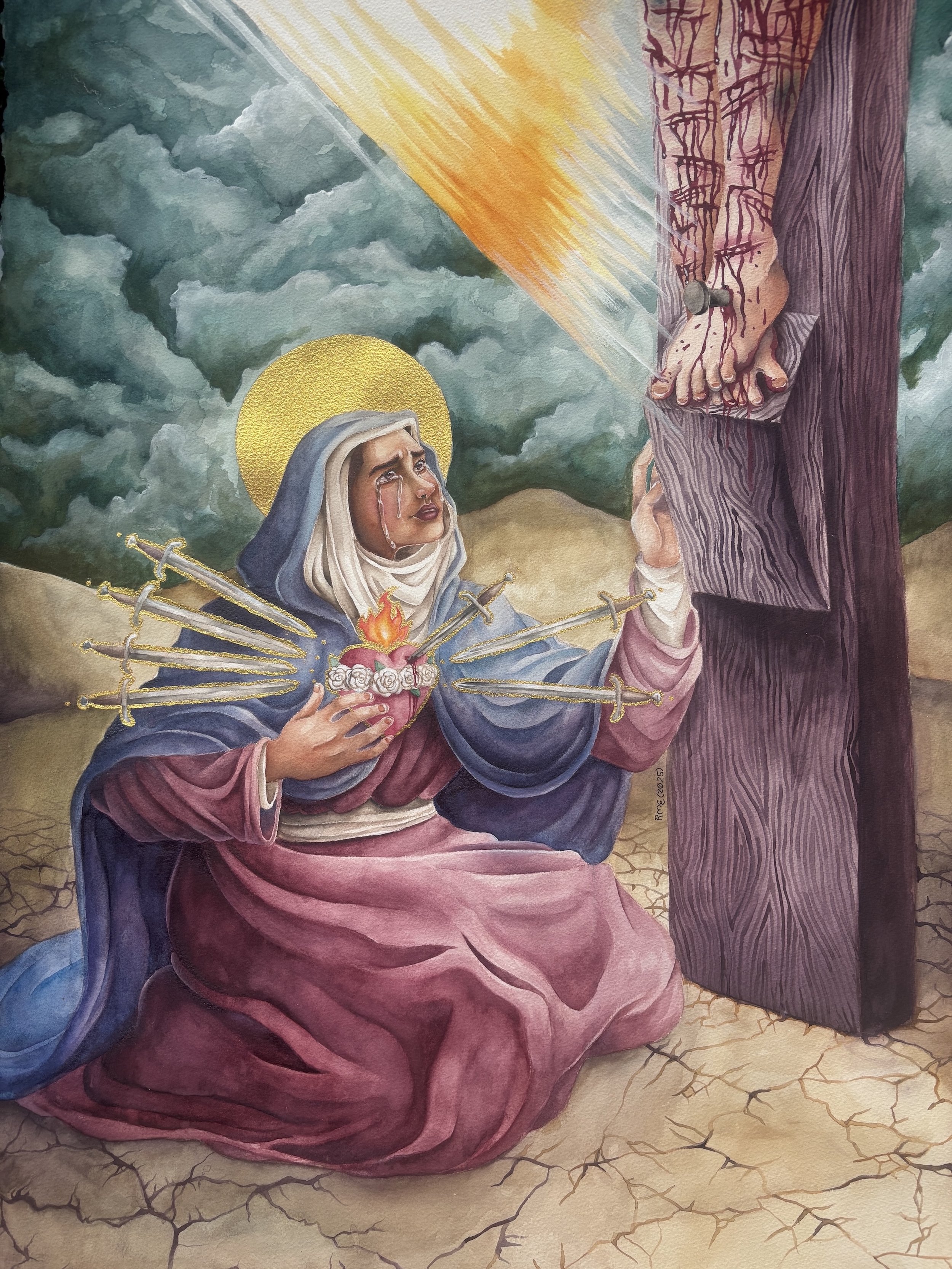
“Her Baby Boy" By Rachel Eligon
The Annunciation Heralds the Incarnation
By John Tuttle
+JMJ+
Today, we celebrate the Annunciation, which is observed as a solemnity in the Church due to its importance. (As a solemnity, we can also celebrate and splurge by enjoying whatever we gave up for Lent.) The solemnity recalls that moment, at once joyous and breathtaking, in which St. Gabriel heralds the Good News to Mary that she has been chosen to become the Mother of God! The angel heralds the Incarnation — God becoming man. Mary’s affirmative response, her Let It Be, greenlights a hugely significant event: the visible entrance of God into the drama of human history.
That word Incarnation comes from the Latin incarnátio. If you break it down further, we can see the root word carnis in it, which means “meat” or “flesh.” This carries over into later Romantic languages. For instance, the Spanish noun carne also means “flesh” or “meat,” typically the kind you’re going to eat. So, when Jesus is incarnated, when He is enfleshed in Mary’s womb at the miraculous moment of conception, He enters His creation. The Creator becomes a creature. He does so in order to save. To offer us Himself, His grace, and His new and abundant life. But the Incarnation has a roundabout way of speaking to artists in particular.
The main purpose of Christ’s Incarnation is His salvific death and resurrection, through which He grants us access to all of Heaven. But the implications of God becoming human are so far-reaching that this act of God’s transformation touches and transforms the entire cosmos, sanctifying matter and elevating humanity. God makes the ordinary extraordinary, raising mere matter to a sacramental role. This transformation, which we can see in countless ways, is most perfectly realized in the transubstantiation of mere bread and wine into Christ’s Body and Blood, whom we receive in Holy Communion.
As already alluded, Jesus incarnates Himself and sanctifies His creatures in myriad (if less extraordinary) ways apart from the Eucharist. Our cosmos is brimming with grace, and God can reveal Himself through the created order. But it is the all-important Incarnation which not only makes possible our salvation but raises creation to a new dignity, since God joined Himself to His creation. By entering the world, Christ shows us the true value of things, the hierarchy of creatures and their purpose. The natural world and inanimate, manmade objects can speak of the glory of God.
Within the first several centuries of Christianity, debate broke out regarding whether icons and imagery ought to be used for religious purposes. Were the faithful at risk of worshipping icons as idols? Some wished to do away with such images. They were the iconoclasts. However, saintly and rigorous thinkers such as St. John Damascene and St. Tarasius of Constantinople condemned iconoclasm as a heresy. While worship of an image in itself is wrong, holy images and art are capable of bringing the viewer into a closer relationship with God, stimulating the imagination and leading to deeper prayer. The same God who became flesh for us so as to be Someone who could be touched, a Baby to be held, the Host to be consumed, can also reveal Himself in tangible images of paint, mosaics, charcoal, and ink.
St. John Damascene invokes the Incarnation to defend the use of holy images, writing that, “Of old, God the incorporeal and uncircumscribed was never depicted. Now, however, when God is seen clothed in flesh, and conversing with men, I make an image of the God whom I see. I do not worship matter, I worship the God of matter, who became matter for my sake, and deigned to inhabit matter, who worked out my salvation through matter. I will not cease from honouring that matter which works my salvation. I venerate it, though not as God.”
God became flesh to connect more intimately with creatures of flesh and blood. And by His life, he gives us an example of striving for perfection by knowing the true value of things. In fact, objects deserve neither to be disdained nor idolized. God knows that human beings not only desire but need created things like food and drink, but He also tells us that these will never truly satisfy the deeper hunger and thirst experienced in the human condition. Man does not live by bread alone. The Kingdom of Heaven is meant to be sought prior to and above all created goods. These creatures made up of matter can draw us either closer to or farther away from God, but they are not God themselves. Thus, they are worthy not of adoration but, at some level, of our admiration. Look at all the good God showers on us! But, at day’s end, these creatures are mere shadows of the underlying reality — the supreme Goodness and Beauty, the personal God who loved us into being.
God has given us life so that we might give of ourselves — of our talents, but especially of our love, like the way Jesus did on the Cross. He constantly invites us to give. He wants us to gain wisdom to understand the true value of items and of actions. Lent is an amazing time to contemplate more deeply the true value of the passing things of this world (hence fasting and abstinence) and cling to the God who became visible and touchable, who is the source of eternal life.
As Venerable (soon to be Blessed) Fulton Sheen writes, “You must remember to love people and use things, rather than to love things and use people.” We use holy images, and any of God’s created goods, as ways to nourish our relationship with God. However, our love is reserved only for persons, both the three divine Persons of the Godhead and the people we walk with in this life. A healthy Lenten exercise might be to reflect if our personal evaluation of the things and people in our lives aligns with the truth. Do we use things and love people the right way? Do the people in my life deserve more of my time than, say, my pursuits and belongings?
As God, Jesus understands what we were made for and the perfection we’re called to. As man, Jesus knows firsthand our needs and temptations and desires for reassurance. He designed this tactile world and entered into it, inevitably placing Himself at the disposal of our senses. Man comes to God, is touched by Him, and healed.
In His supreme Incarnation, Jesus does more than any of us as artists could ever do. He makes the invisible God visible and touchable. He becomes carnis, carne, flesh of our flesh! And the good work He has begun in us He plans to bring to fruition, ultimately to raise up and restore us in mind, body, and spirit.

John Tuttle loves writing and photography. He, his wife Ellen, and their family live in Illinois.

Rachel Eligon is an artist and writer living in southern California with her beloved husband, Alex. You can find out more about her on her website, rachelmeligon.com.