
The Third Sunday of Advent
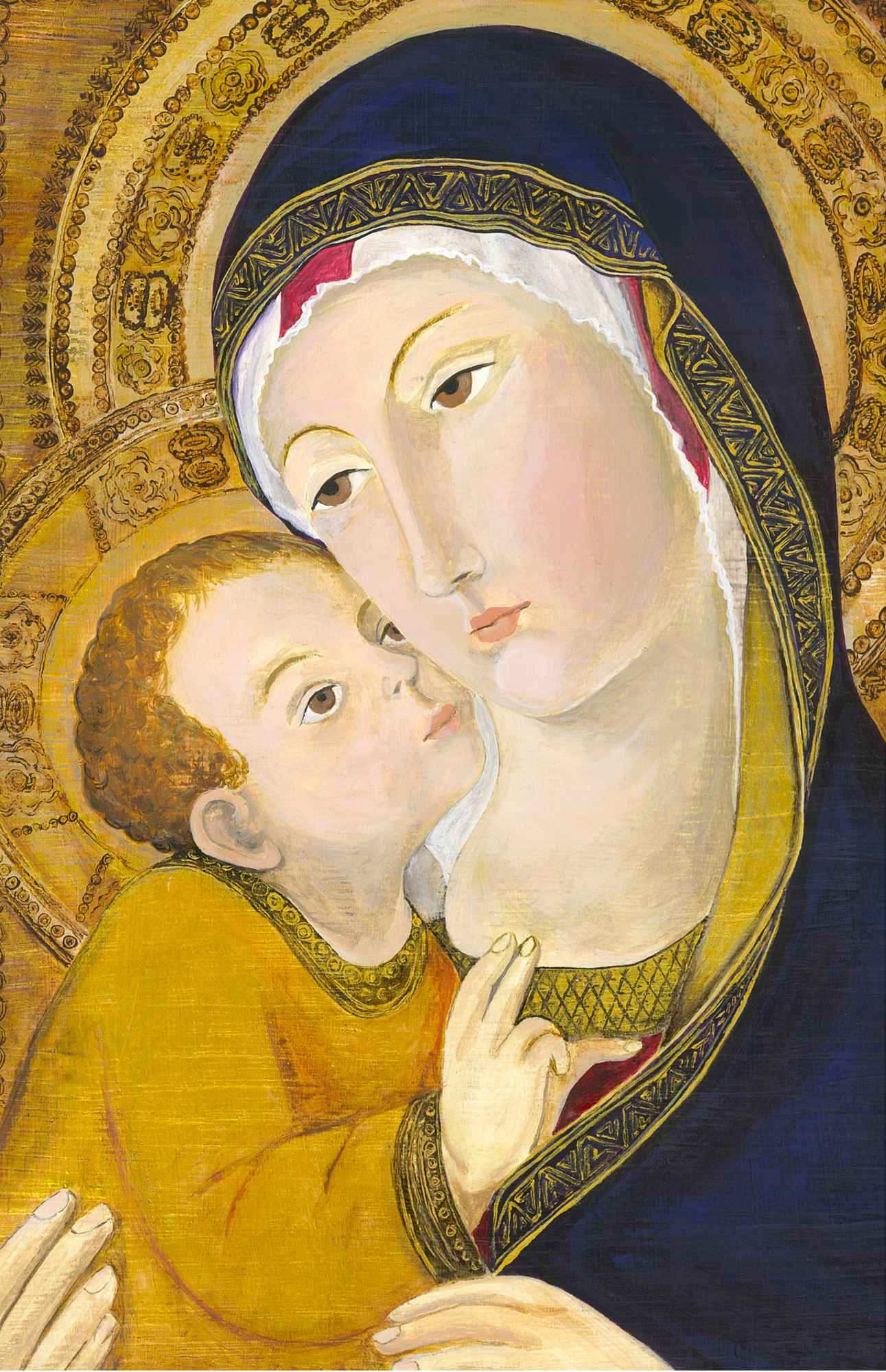
“Golden Madonna” by Maureen Armendariz
Three Spiritual Lessons from John of the Cross
By John Tuttle
+JMJ+
Today is the third Sunday of Advent, a feast which outranks the saint’s feast day observed every Dec. 14—that of St. John of the Cross. Contemporary, co-reformer of the Carmelite Order, and comrade of St. Teresa of Ávila, John’s best-known writings in Christian circles are his poetry and his book Dark Night of the Soul, which delves into the soul’s journey to God and emphasizes the necessity of self-denial in the process.
Beyond religious readers, he holds a reputation for being one of the finest Spanish poets. But the beauty he wrought with the pen was only possible due to the beauty of his soul in an intimate relationship with God. In writing poetry, John of the Cross is no outlier among the saints. Many have expressed their love of God in verse. Others, like Blessed Fra Angelico and St. Albert Chmielowski, glorified God on Earth via visual art.
Let’s dip into the ocean of wisdom John of the Cross offers regarding the faith. He can lead us not only to clarity in our creativity but, more importantly, into a deeper relationship with Jesus Christ. We’ll look at three points from the saint’s theology that can help us.
First, is detachment, which comes about through mortification. When we detach our desires from earthly things, our desires focus more on God, the Giver of all those things. The appetites for lower things sully the soul’s beauty, John says. In contrast, he writes that people who free their hearts of the clinging ivy of this world, experience liberality of spirit and deeply enjoy such things in an uncovetous manner:
They obtain more joy and recreation in creatures through the dispossession of them. They cannot rejoice in them if they behold them with possessiveness, for this is a care that, like a trap, holds the spirit to earth and does not allow wideness of heart.
And elsewhere:
They delight in these goods according to the truth in them, but those who are attached delight in the worst; they delight in the substance of them...
The saint tells us that we can enjoy earthly goods more—not by gorging on them, but by partaking in them with moderation and regular denial. What is more, when we do this, we begin to enjoy the deeper reality of these things.
Marc Foley, editor of The Ascent of Joy: Selected Spiritual Writings of John of the Cross, likes to illustrate this with a literary anecdote from Charles Dickens. In A Christmas Carol, after Scrooge is reformed and has a liberality of spirit, he goes to church and walks about town, finding “that everything could yield him pleasure.” In the story, Foley says, “I believe that [Dickens] is saying that when we take a possessive, grasping, clutching stance toward life, as Scrooge did at the beginning of the story, we make ourselves miserable. But when we approach creation with gentleness, reverence, respect, and non-possessive love, it yields to us what we are seeking.”
Abstaining from real goods (or refraining from selfish or controlling covetousness), something which often entails an element of suffering, is good for us!
John of the Cross faced many difficulties, especially when he wished to reform the Carmelites. In the 1570s, he was imprisoned multiple times. But it was in the midst of these hardships, in the darkness of his confinement, that he composed some of his most illuminating poetry. The detachment from creatures (all created things) was an important spiritual dimension which he lived out. Prison was not permanent, and he later helped establish the Discalced Carmelites.
Trials can be purifying—if we accept them in a manner where we acknowledge we’re not in control. Through the struggle comes blessing. Through the trials of the desert, the Israelites reached the Promised Land! We hear something similar in today’s readings: “The desert and the parched land will exult/the steppe will rejoice and bloom...They will bloom with abundant flowers/and rejoice with joyful song.” The desolate place gives way to a veritable Paradise, and fasting gives way to feasting. Suffering, even little instances, can be big sacrifices to God, and this includes fasting from transient things so as to better sense the transcendent.
Iconographers go through a period of prayer and fasting before creating an icon of Jesus, the Blessed Mother, a saint, or some holy scene. Freely depriving ourselves of worldly pleasures opens us up to both heavenly realities—and the fullness of earthly realities too. Not only is fasting from worldly goods something the Church and the saints offer us to emulate, it can also enhance the artist’s ability to see the true value of created goods as lower than God, the Supreme Good, and as instruments leading us to Him. If we are going to communicate truth beautifully, then we must have a firm grasp of Truth Himself (cf. John 14:6). After all, we can’t give what we don’t have.
The second gem extracted from the theology of John of the Cross is the importance of contemplation, which he identifies as “God’s self-communication.” We experience contemplation when we have a deep, personal knowledge of God, which is felt “as a loving or peaceful awareness.” It’s not something that’s forced. It’s God’s gift.
John of the Cross says that beginners who strive for the contemplative state often fail to realize “the delicate and subtle way that God is present.” Artists feel things more keenly than many other people. Beyond what is going on externally, we have the God-given calling to search out the things of the spirit, and not only of the flesh. God’s presence is constant, like waves caressing the sands of the shore. But it is often subtle. We need to strive for greater silence, stillness, and the loving, peaceful awareness of God’s presence. When we experience such contemplation, then we can give to others the fruit of that contemplation, just as it was a gift to us.
Third and lastly, the soul is beautiful, more so when it is closer to God and His image. But it becomes less so (it gets disfigured) when we sin and turn from God. When the soul is virtuous and animated by love, it is most beautiful. Referring to the soul in the feminine, as the Bride of Christ, John writes that there’s a “whole abyss of riches and delight he has placed within her.” The riches are the virtues and gifts given and cultivated by God.
Again, we cannot give to others what we don’t have in ourselves. That goes for truth. That goes for peace. It goes for beauty, too. If we wish to transmit the truth, beauty, and goodness of the Gospel, we first need to search out the truth and beauty of a real relationship with the triune God. Advent invites us to work on this.
John Tuttle is husband to Ellen and dad to Elizabeth. He is a writer and the communications coordinator for the Diocese of Rockford's LiFE Office.
Maureen Armendariz is a painter, jewelry designer, urban homesteader, and homeschooling mom in Omaha, Nebraska.