
Babette’s Feast as a Lenten Parable
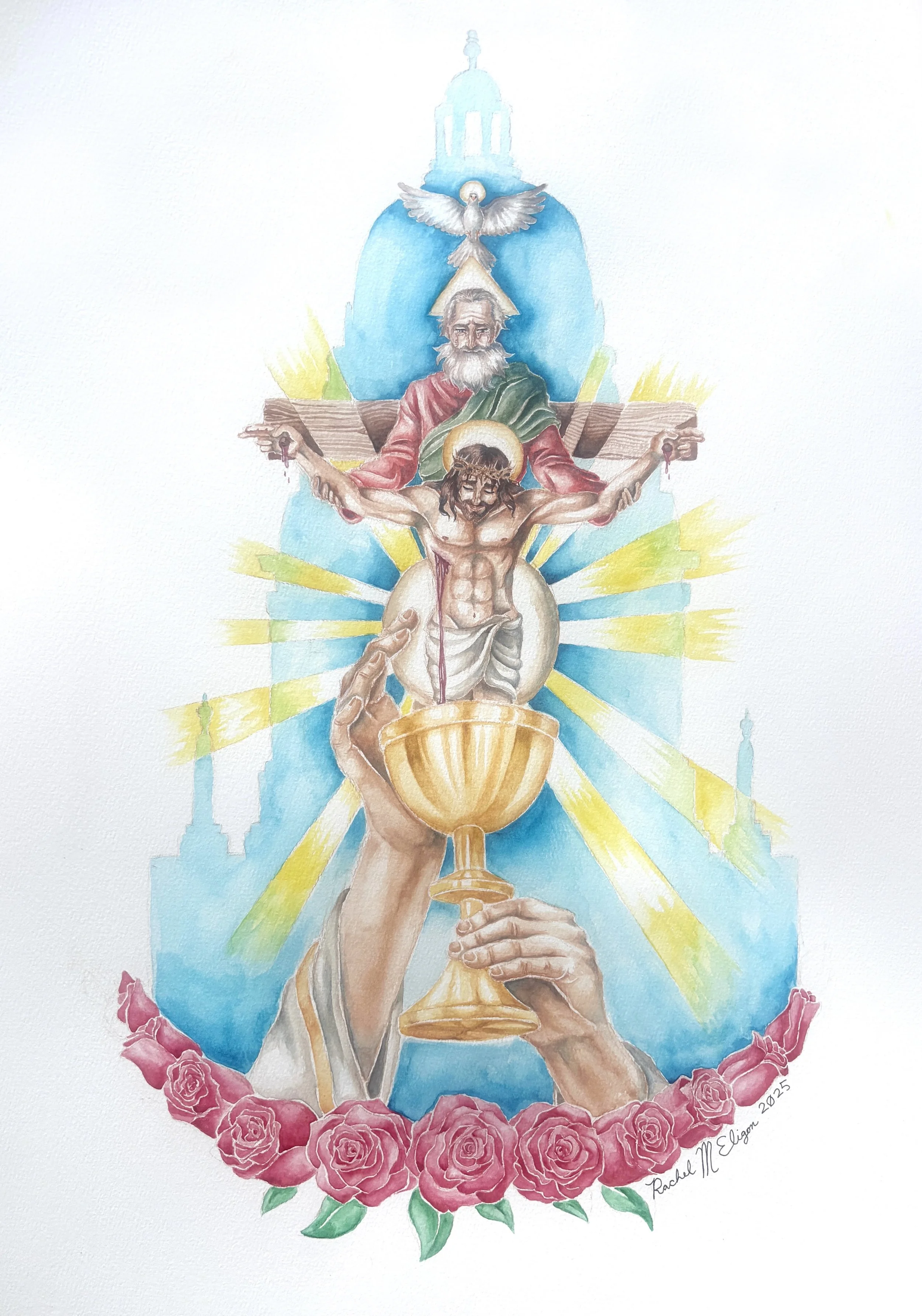
"Body, Blood, Soul, and Divinity” by Rachel Eligon
Babette’s Feast as a Lenten Parable
By Julia Morrow
One of my favorite films to revisit during Lent is Babette’s Feast, the luminous 1987 Danish drama directed by Gabriel Axel. Set in a remote fishing village in nineteenth-century Denmark, it tells the story of two devout Protestant sisters, Martine and Filippa, who faithfully shepherd the small Pietistic Lutheran congregation founded by their late father.
Their quiet life is interrupted when Babette, a refugee fleeing political violence in Paris, arrives at their doorstep seeking shelter. They take her in, but what they cannot foresee is that she will remain with them for fourteen years, serving as their housekeeper and cook. Nor can they imagine that one day she will win the French lottery and choose to leave the fishing village, preparing an extravagant “real French dinner” for the sisters and their community before she does.
Everyone enjoys the feast that Babette has prepared for them, slowly letting go of their initial ascetic reservations and delighting in the extravagant food, delicious wine, and shared company. At the end of the film, it’s revealed that Babette spent all of her lottery funds on the feast that she prepared. One of the sisters wrings her hands, saying “now you will be poor for the rest of your life!”
Babette replies: “An artist is never poor.”
Babette’s Feast is a deeply beautiful film. It is a feast for the senses and the soul, visually articulating enduring themes of hospitality, self-sacrifice, and incarnational faith. The most apparent of these themes, of course, is the way in which Babette’s relationship to the puritanical community serves as an allegory for Christ’s actions on behalf of all people, with her elaborate feast representing the Eucharist.
Many Catholics speak of desire primarily in terms of restraint or renunciation, similar to the townspeople in the film. Lent, especially, can feel like a season of suppression. However, Babette’s Feast suggests that our desires are not meant to be eradicated but transformed. In sacrificing her funds to prepare a generous feast, Babette models the kind of self-offering that Lent asks of us. This is articulated in Gaudium et Spes: the idea that man cannot truly find himself “except through a sincere gift of himself.” Through her meal, Babette tells the townspeople a story of a world redeemed by love.
This reminds me of a beloved passage in Wendell Berry’s Jayber Crow (emphasis my own): “And when church was over they would go home to Heavenly dinners of fried chicken, it might be, and creamed new potatoes and hot biscuits and butter and cherry pie and sweet milk and buttermilk. And the preacher and his family would always be invited to eat with somebody and they would always go, and the preacher, having just foresworn on behalf of everybody the joys of the flesh, would eat with unconsecrated relish.”
Babette’s Feast serves as one of my annual rewatches because it posits a poignant Lenten parable, reminding us that Lent is not merely about “giving something up” or the “denial of worldly things” but rather, redirecting our attention, though both sacrifice and self-gift, towards preparing our hearts for Christ’s feast, so that we, too, might eat with unconsecrated relish.

Julia Morrow is a writer and theologian based in San Diego, California. You can learn more about her here.

Rachel Eligon is an artist and writer living in southern California with her beloved husband, Alex. You can find out more about her here.