
On Poetry as a Participation in the Divine
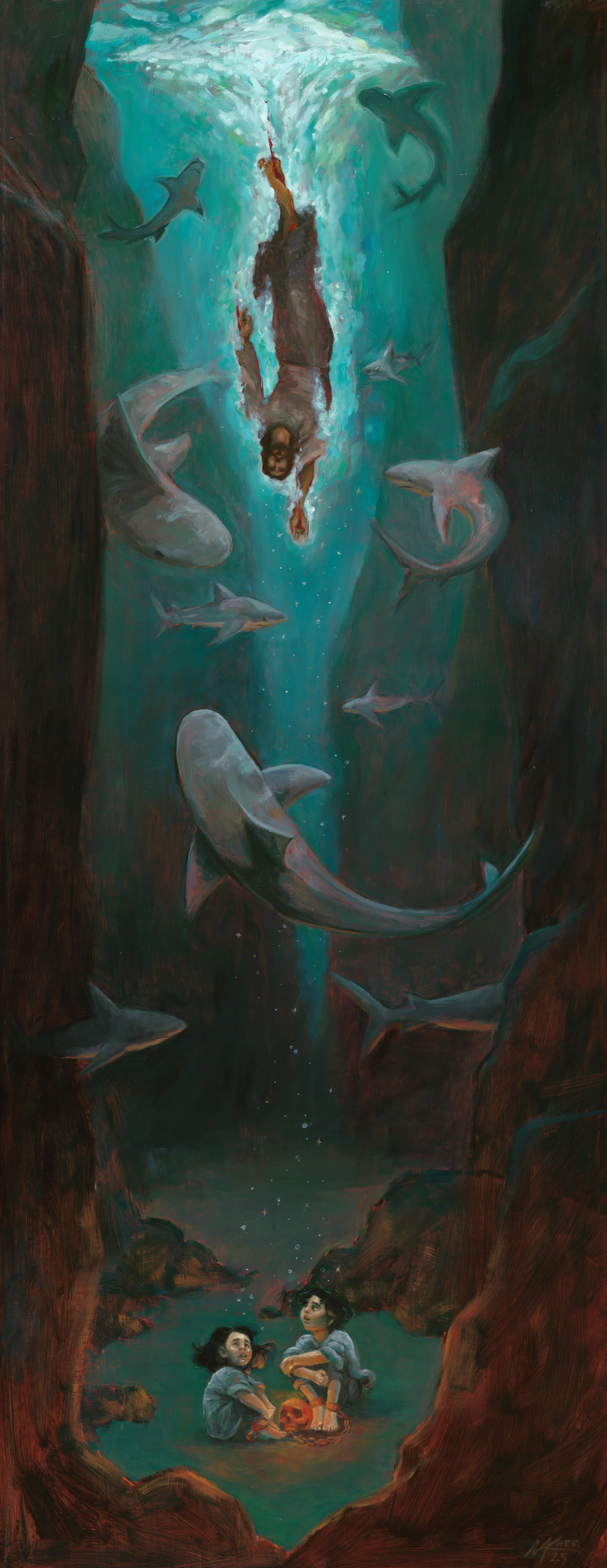
“Lord of the Abyss” by Mattie Karr
On Poetry as a Participation in the Divine
By Sean McCullough
It’s been pointed out in many places that, just as death came to us from a tree, so too did life. God rhymed, so to speak, the occasion of our downfall with the occasion or our redemption. We break no new ground to say that the Crucifixion was an outpouring of love. But consider for a moment: Can every act of creativity also be an act of love? Of redemption? The better question, perhaps, is whether creativity can possibly withhold itself from loving. Not from God’s perspective, it would seem.
As we have observed, Jesus’s Passion was a kind of rhyming to the disobedience of Adam in the Garden. It was no accident that our Lord said with his eyes full of tears, “Your will, not Mine, be done!” He spoke those words, after all, in another Garden. In Latin the phrase is rendered fiat voluntas tua. But what if the rhyming began earlier? Well, Jesus wasn’t simply rhyming with Adam. He was also echoing the words of his own Mother, who offered God a fiat of her own, and who was (not so coincidentally) rhyming her act of obedience with Eve’s act of disobedience. Freedom for freedom, will for will.
Mother and Son each give the Father a free offering of themselves. This is good. But it is not good for the man to be alone. Another relationship was lost in the first Garden besides that of God and Humanity: Man and Woman. If the two remain separated, then even attempts to do good will remain incomplete. Now the Wedding at Cana is often held out as Christ’s blessing of Marriage, and rightly so. But as with the example above, Jesus was about his healing, rhyming, loving mission well before that point. In fact his very entry into the world brought about the beginnings of the healing of the ancient divide between Man and Woman.
Consider Joseph, receiving the news that Mary his wife was pregnant with a baby very much not his own. He was probably saddened and was definitely afraid, because Matthew tells us so in his Gospel. “Do not be afraid,” says the angel, “to take Mary your wife into your house.” What was he afraid of? That his bride was not what he had hoped? That she could not, in fact, be trusted? If we remain skeptical that this same ancient rift was threatening to divide the Holy Family, we should consider that the first words from Adam’s mouth after he ate the fruit were, “I was afraid.” His first action was to protect himself, to cover himself from the woman’s gaze. Joseph too sought protection in the face of his fear. His “covering” was a provision in the Law to write Mary a bill of divorce. Not that he wanted to hurt Mary; scripture tells us that he was righteous yet unwilling to expose her to shame. Nevertheless, the fear was there, an ancient fear born of an ancient wound.
What answers that fear but another birth? After the angel enjoins Joseph not to be afraid, he reveals that the Child was conceived by God’s own ruach, his breath, his Spirit. In that moment, Joseph was given a glimpse of God’s great love poem with humanity, and he was no longer afraid. God gave his own image back not just to Man or just to Woman, but to Man and Woman. Through Mary’s surprise pregnancy, taken to be a sign of her union with a man, God restored the trust between Mary and Joseph. In a very real way, he restored their union. Through the healing of that divide between a particular man and a particular woman, Jesus Christ in his very person began to heal the ancient sundering between Man and Woman. Poetry indeed.
Sean McCullough is a New York City-based photographer and actor.
Mattie Karr is on a mission to help Jesus heal hearts through beauty. Based in Kansas City, KS, her sacred art and behind the scenes videos can be found on her website here: www.mattiekarr.com