
The Cycle of God’s Word
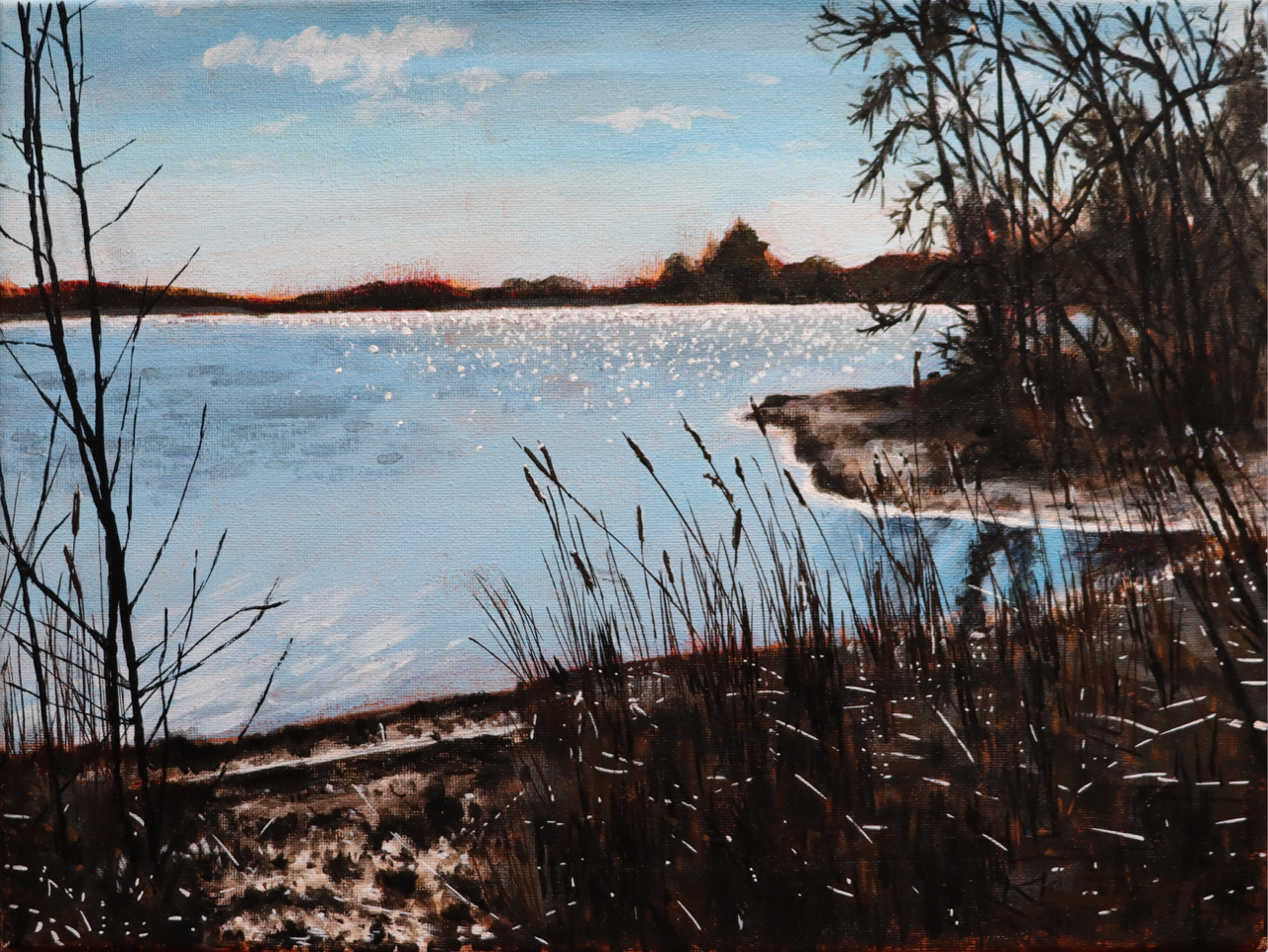
"Stony Creek Winter Cove 1” by Susan Young
The Cycle of God’s Word
By Jane Wageman
I think of Lent, usually, as a desert. I picture Jesus going out to a barren landscape for forty days. I imagine the season’s ascetic practices creating a somewhat stripped-down space inside me, less cluttered by the usual distractions, but also harsh and unprotected.
The readings in Lent contain this kind of desert imagery—but they include so much water as well. In today’s reading, water, in the form of rain and snow, is tied to God’s word.
Just as from the heavens the rain and snow come down
And do not return there til they have watered the earth
. . .
So shall my word be
That goes forth from my mouth
When I read this, I pictured the water cycle charts that appear in elementary school textbooks, tracing the stages of precipitation, evaporation, and condensation. I saw the arrows following the rain down from the clouds to the plants and back up again.
Praying with this reading, I found myself entering into different parts of that water cycle. I saw myself, first, as a plant watered by God’s word, adopting the familiar posture in prayer where you let the images and language wash over you—then sit with a single word or phrase.
But the scripture continues. The word issues forth from God, but it does not merely land on the earth and stay there. Instead, God insists, “It shall not return to me void, but shall do my will, achieving the end for which I sent it.” The water transforms what it touches, makes it “fertile and fruitful.”
So I imagined myself, also, as the water evaporating out from the plant and back up to the clouds. I asked: How does God’s word flow through me? How does it enter into my own words—my artistic practice?
Sitting with these questions, I recalled a Lent, several years ago now, that did not feel like a desert at all. I was writing poetry and praying Lectio Divina with the first readings, noticing all this water imagery, and finding my spiritual life at its fullest. Store this up, I thought. You’ll need it later.
But the spiritual life doesn’t quite work like that. You can’t keep a cellar of wealth in reserve for periods of time when you find yourself lacking. It does, however, often, move in cycles. And what I love about Lent, or any liturgical season, is the return to a set of readings. The lectionary allows you to encounter the same images and words at another point in time, to receive them again, differently. To let them work upon you in new ways each time. To remember, too, how many people these same words have cycled through—how many words and works have come out of them.
This Lent, I wondered, how will I receive the word? What form will it take, returning to God?

Jane Wageman is writer and teacher, currently completing a residency at the Collegeville Institute in Minnesota. You can find out more about her here.
Susan Young's artwork highlights the wonders this world our God created. Her subjects are mainly landscapes, still lifes, and birds portrayed in various 2D media.