
December 3rd, 2025
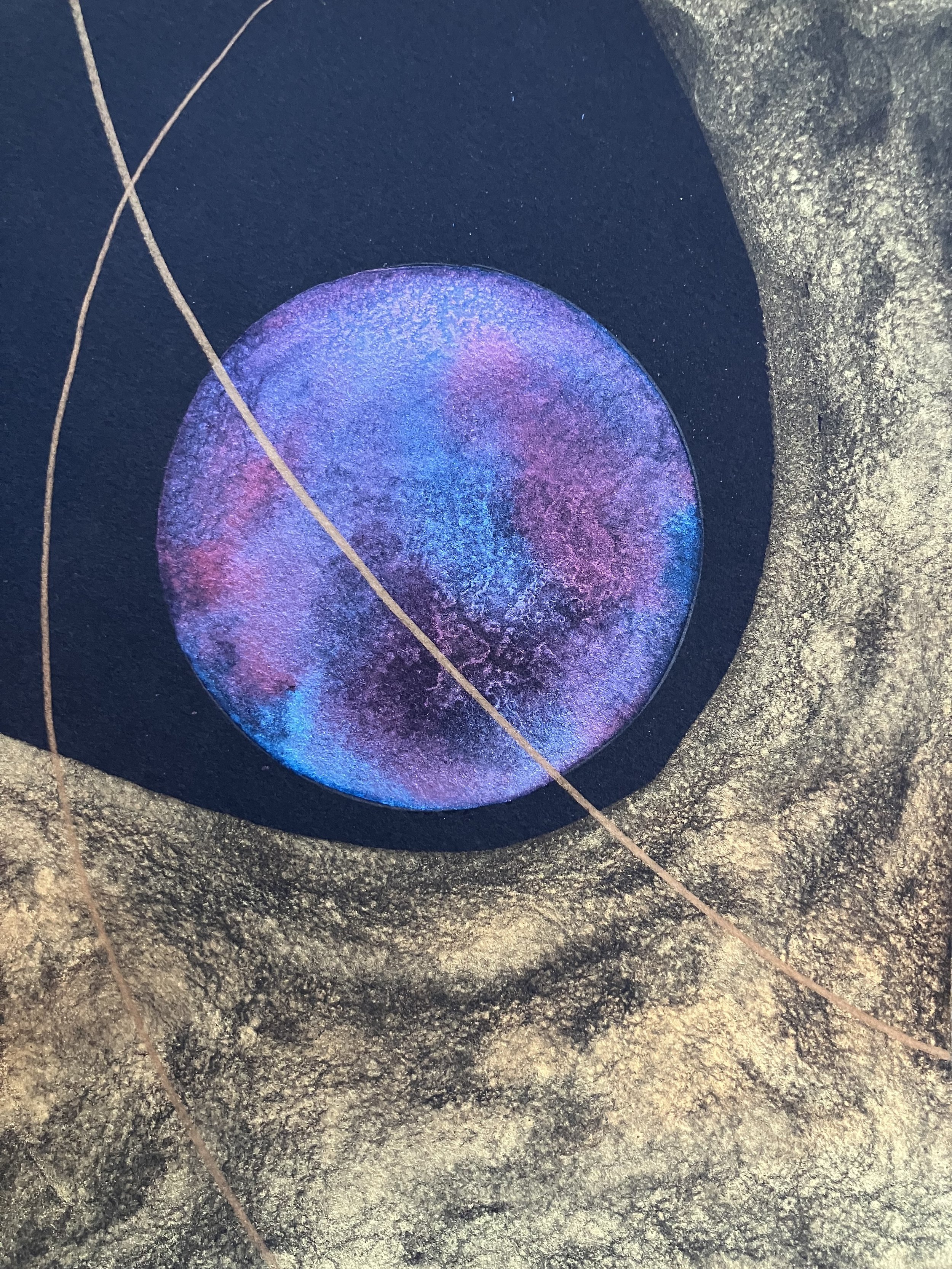
“Celestial” - By Susan Black
Three Practices
By Susan Black
As we look forward to a fruitful Advent, it’s not too early to ask: How can we extend the blessings of this holy season into every day of every year? Three practices may help:
First, adopting an overall “Advent attitude” in our lives.
Consider that Advent has a dual nature, being situated in the here-and-now, the present moment, but also being oriented to the future. Therefore, we’re always in Advent. Everyone is.
We’re always moving towards something, something that’s always ahead of us, even if we’re not aware of what it might be. Our present moment is not inert but involves growth. We embrace the Advent attitude of waiting, not passively but actively. This attitude involves expectation, anticipation, and preparation.
As people of faith who want to grow in our faith, what do we most dearly expect and anticipate?
Being with the Lord, of course. With that as our goal, why would we prepare for the Lord only four weeks once a year?
Consider what the USCCB says about “the theology of Advent”:
“Advent has a twofold character, for it is a time of preparation [when] the First Coming of the Son of God to humanity is remembered, and likewise a time when, by remembrance of this, minds and hearts are led to look forward to Christ’s Second Coming at the end of time.”
This statement provokes some questions: What do we do during the time in between the First and Second Coming, when we “are led to look forward?” Do we, in fact, “look forward”—which is a positive, active stance—or do we merely peer ahead anxiously or doubtfully? How do we spend our God-given gift of time? How do we live our lives?
Second, creating an “inner monastery.”
This monastery is not a specific place, but a metaphor for all the holy attitudes to be cultivated in our spiritual lives; these include peace, quiet, stability, joy, depth, hope, and Advent.
With our monastery as the core of our hearts and souls, we can slow down and avoid being distracted by the hurly-burly of modern life, the demands of everything else we face daily, what we choose or what is forced upon us. Throughout the year, we can maintain our spiritual focus and act in a way that helps build God’s kingdom for all people.
Our inner monastery is not a sealed-off chamber where we languish in isolation and passivity. Rather, within its beauty, we’re nourished and fortified for our Christian task. That task involves living in hope, waiting with confidence for the Lord’s coming and expressing that confidence even in the chaos of today’s world.
Third, calling on the intercession of Mary, the Blessed Mother.
Mary, holy exemplar of Advent attitude, can help us create our inner monastery, because she had her own such sanctuary. Recall that the second chapter of Luke’s Gospel tells us, not once but twice, how Mary treasured what she kept in her heart about Jesus. Who knows better than she what it’s like to expect, anticipate, and prepare for His Coming?
Perhaps now is the time to dedicate, or re-dedicate, ourselves to one or more of the Church’s rich devotions centered on Mary. Perhaps we could resolve to pray the Rosary more often, or the Memorare, or the beautiful ancient Litany of all her attributes. Or practice visio divina with artists’ images of Mary, the Nativity and the Holy Family.
Let us pray that Advent 2025 will teach us new ways to live the truth of this statement by the great German priest and theologian Johannes Baptist Metz (1928-2019), from his book The Advent of God: “Our Christian faith involves a continuing effort to keep ourselves open to the coming of God.”
Susan Black is an artist, writer and Benedictine Oblate living in Aurora, Oregon. You can learn more about her at BlackStarStudio.me.